
Quick answer: Booking direct with a shipping line works when you are moving full containers (FCL) on a simple lane, already hold a Customs Broker Licence or an in-house broker, and can coordinate landside transport yourself. For everyone else, including LCL shippers, first-time importers, businesses juggling multiple origins, and anyone who wants one team handling sea, air, customs and delivery, a freight forwarder is almost always cheaper once detention, documentation and clearance errors are factored in. The real question is not ‘do I save by going direct’. It is ‘can I afford the time and risk of being my own coordinator’.
Direct carrier booking looks cheaper on paper. Shipping-line websites publish per-TEU rates, and it is tempting to assume a freight forwarder’s quote is just that rate plus a margin. In practice, the two models solve different problems, and the wider ecosystem (carriers, forwarders and 3PLs) each play distinct roles. If the role distinction is new to you, our breakdown of the differences between a freight forwarder, a carrier and a 3PL sets the context. Here is what you are actually choosing between.
When direct carrier booking actually works
You are moving regular FCL on a simple lane
If you are shipping 20-foot or 40-foot containers on a fixed weekly rotation, say Shanghai to Port Botany, and you have done it ten or more times, going direct removes a middle party. You know the sailing schedule, the carrier contacts, the documentation set, and the receiving routine on the Australian side.
You hold an in-house customs capability
Direct booking still requires an Australian customs entry. If your business already employs a licensed customs broker, or you have trained someone to lodge declarations through the Integrated Cargo System (ICS), you can handle clearance in-house. Without that, you still need to engage a broker, and most brokers are also forwarders. Our guide to how customs brokerage works in Australia covers what the role does and where in-house handling becomes practical.
Your cargo is simple and your receiving site is straightforward
Dry cargo in standard containers, no temperature control, no dangerous goods, no biosecurity risk, and a site that can receive a side-loader or tilt-tray with normal notice. That is the profile where direct booking is manageable. The moment any of those factors gets complicated, you are back to needing a forwarder.
When a freight forwarder is the right call
You are consolidating LCL cargo
Shipping lines do not take LCL bookings directly. Less-than-container-load cargo has to be consolidated at a Container Freight Station (CFS), and that is forwarder territory. If your shipment is under about 15 cubic metres, a forwarder is non-optional rather than a preference. For the FCL versus LCL decision in more detail, or our quick-reference FCL or LCL guide, both outline when each option makes sense.
You are importing varied cargo or across multiple origins
If you are sourcing from China, Vietnam and India in the same quarter, a forwarder quotes against lane expertise and consolidates visibility. Managing three separate carrier accounts, three invoice sets and three customs clearances is the work that pays a forwarder’s fee back before the containers berth.
You want one accountable team across sea, air, customs and transport
A shipping line is responsible only for the port-to-port leg. Origin pickup, export clearance, Australian customs, biosecurity, landside transport and warehouse delivery sit outside their scope. A port-to-door forwarder stitches those together and takes responsibility for the whole journey, which is the operating model Sea Logic was built around. Read more about the port-to-door approach and what it covers.
You are a first-time importer
Incoterms negotiation (we cover FOB, CIF, EXW and DDP in detail here), bill of lading surrender, letter of credit document sets, tariff classification and biosecurity treatment. The cost of learning these on a live shipment is higher than any direct-booking saving. A forwarder absorbs that learning curve. Our first import shipment guide walks through what to expect on a first cargo move into Australia.
The real trade-offs
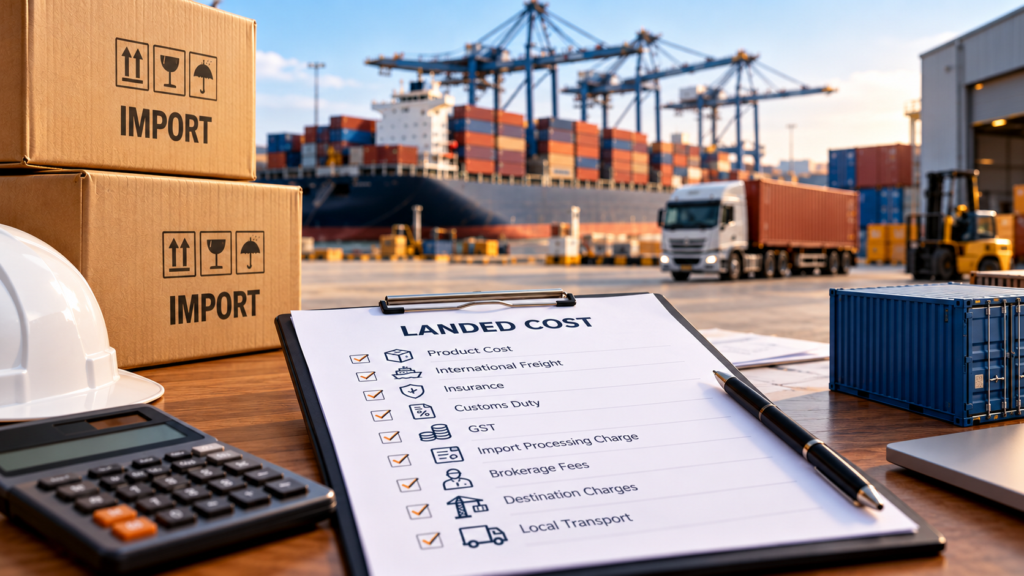
Direct carrier rates often look $200 to $400 lower per TEU than a forwarder’s rate. But a single day of detention at an Australian terminal can run $300 to $500 per container, and a documentation error that triggers a customs hold costs more than a year of forwarder fees. The direct-booking saving is real only when nothing goes wrong, and on international freight, something going wrong is the baseline expectation rather than the exception. We unpack this in more detail in our guide to comparing freight rates versus total shipping cost. A related read on why sea freight shipments get delayed covers the specific disruption patterns that erode direct-booking savings.
What you get when you work with Sea Logic instead of booking direct
Sea Logic coordinates sea freight, air freight, customs brokerage, port transport, project cargo and warehousing and distribution as one connected service. We have moved more than 125,000 TEUs for over 450 customers across 65 countries since 2018, with offices in Melbourne, Sydney and Brisbane. Our Annual Carriers’ Meet relationship with shipping-line partners means we hold direct carrier contracts. That is the pricing benefit of going direct, with the coordination layer added back.
You get one point of contact who can flag a document issue before it becomes a customs hold, reschedule landside transport when a vessel is delayed, and keep container detention off your invoice. That is what the port-to-door operating model actually does.
Practical details on getting started
For a first forwarder conversation, have four things ready: the supplier’s address and cargo type, the commercial invoice value, the agreed Incoterm (FOB, CIF, EXW, DDP), and the destination address. Our shipment checklist covers the full information set. A working quote typically lands within one to two business days. There is no onboarding fee and no volume commitment to open an account.
Where to go from here
If you are weighing whether to engage a forwarder for your next shipment, our team in Melbourne, Sydney or Brisbane can scope it with you against your current direct-booking workflow. For exporters moving in the opposite direction, the export planning guide covers the parallel process for sending cargo out of Australia. You can also get in touch for a tailored quote.
Frequently asked questions
Can I book sea freight directly with a shipping line as an Australian importer?
Yes for FCL. Most major carriers accept direct bookings from shippers with a valid account. No for LCL. That has to go through a freight forwarder with CFS consolidation capability.
Is it always cheaper to go direct to the carrier?
No. The per-TEU rate is often lower, but direct booking excludes customs clearance, landside transport, documentation handling and issue resolution. Once those are added back, forwarder pricing is usually comparable or lower, and significantly lower once detention, demurrage or clearance delays occur.
Who handles Australian customs if I ship direct with a carrier?
You do, either through an in-house licensed customs broker or by engaging a broker separately. Carriers do not lodge import declarations on your behalf.
What does a freight forwarder do that a shipping line doesn’t?
Origin pickup from your supplier, export clearance, consolidation, document preparation, Australian customs clearance, biosecurity coordination with DAFF, port transport booking, detention management, and delivery to your warehouse or distribution centre.
When is a forwarder essential and when is it optional?
Essential for LCL, first-time imports, multi-origin sourcing, temperature-controlled cargo, project cargo and anything requiring customs brokerage. Optional for experienced FCL shippers on simple, repeat lanes who already handle their own customs.