
Product price plus freight is not your landed cost. Not even close.
Every week, Australian importers set their retail prices based on the supplier invoice and freight quote, then discover after clearance that their actual cost of goods is 30 to 50 per cent higher than they budgeted. Margins vanish. Deals that looked profitable turn into losses.
Landed cost calculation is the fix. Done properly before you place an order, it gives you a complete picture of what your imported goods will actually cost by the time they reach your warehouse. Done poorly (or not at all), you are guessing.
This guide walks through the landed cost formula, shows a worked example and gives you a step-by-step process for estimating your landed cost accurately.
Table of Contents
1. What Is Landed Cost?
2. Why Estimating Landed Cost Matters
3. The Landed Cost Formula
4. The Cost Components in Detail
5. Worked Example: Landed Cost Calculation
6. How to Estimate Before You Order
7. Common Landed Cost Mistakes
8. Key Takeaways
9. FAQs
1. What Is Landed Cost?
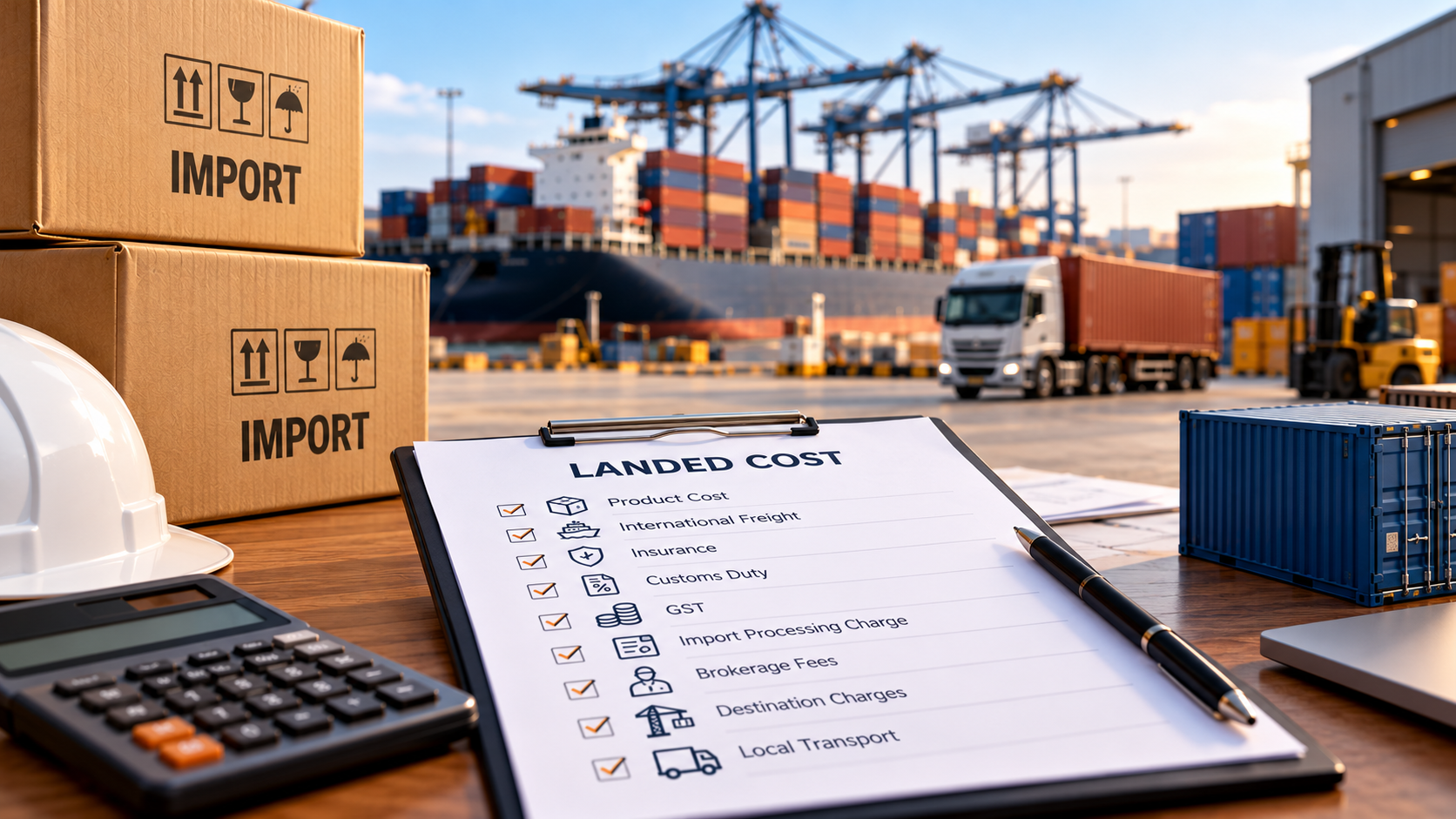
Quick Definition: Landed cost is the total cost of getting a product from your overseas supplier’s premises to your warehouse in Australia, ready to sell or use. It includes product cost, international freight, insurance, customs duty, GST, brokerage fees, port charges, handling and local transport. It is the real cost of goods sold that you should use for pricing, margin and profitability decisions.
Landed cost is what your business actually pays. Supplier price is only part of that.
2. Why Estimating Landed Cost Matters
- Accurate pricing: setting retail prices based on supplier cost alone will erode your margin every time.
- Realistic margin analysis: your gross margin is only meaningful when calculated on true landed cost.
- Cash flow planning: knowing the full cost lets you budget for duty, GST, brokerage and destination charges before they hit.
- Supplier comparison: comparing suppliers on invoice price is misleading. A supplier with a slightly higher unit cost may deliver a lower landed cost if their location, packaging or shipping is more efficient.
- Sourcing decisions: goods from a country with an active Free Trade Agreement may cost less landed than the same goods from a country without one, even at the same supplier price.
Underestimating landed cost is the single most common cause of margin loss for new importers. See our full breakdown of Australian import costs for the complete picture.
3. The Landed Cost Formula
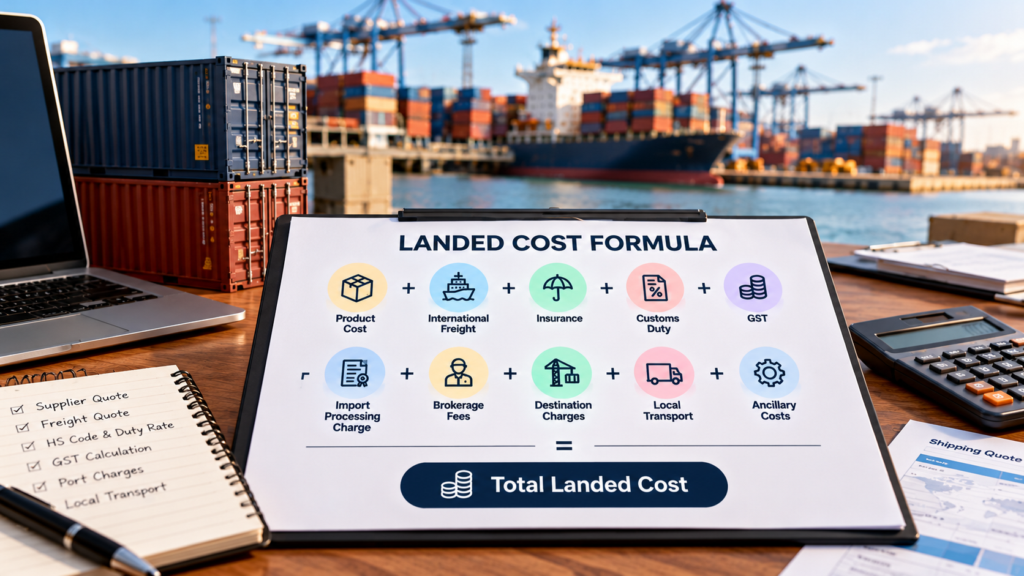
Formula: Total Landed Cost = Product Cost + International Freight + Insurance + Customs Duty + GST + Import Processing Charge + Brokerage Fees + Destination Charges + Local Transport + Ancillary Costs
The formula is straightforward. The complexity is in gathering the right numbers for each component before you commit to the order.
4. The Cost Components in Detail
| Component | How to Estimate | Typical Range |
| Product cost | Supplier invoice (FOB value) | Per supplier quote |
| International freight | Quote from freight forwarder | $800-$3,000+ per 20ft (Asia); $3-$8/kg (air) |
| Marine insurance | 0.3% to 0.5% of CIF value | ~$30-$100 for typical container |
| Customs duty | % of FOB based on HS code | 0% to 5% for most goods |
| GST | 10% of (CIF + duty + IPC) | 10% (reclaimable if GST-registered) |
| Import Processing Charge | ABF fee | $50 ($1K-$10K value) / $152 (over $10K) |
| Customs brokerage | Broker fee for lodgement | $150-$500 per entry |
| Destination charges | Terminal handling at Aus port | $300-$800 per container |
| Port transport | Cartage from wharf to warehouse | $300-$800+ depending on distance |
| Biosecurity (if applicable) | DAFF inspection/treatment | $46+ document assessment; varies for physical |
Expert Tip: If you are GST-registered, you can claim import GST back as an input tax credit on your BAS. This effectively removes GST from your landed cost calculation for margin purposes, but you still need to fund it at clearance. Ask your customs broker about the Deferred GST Scheme to improve cash flow.
5. Worked Example: Landed Cost Calculation
Here is a realistic example for an Australian business importing 500 units of consumer electronics from Shenzhen, China, by sea freight (FCL 20ft container):
Product cost (FOB): $12,000 ($24 per unit x 500 units)
Ocean freight (FCL 20ft): $1,400
Marine insurance: $55
CIF value: $13,455
Customs duty (5% of FOB): $600
Import Processing Charge: $152
GST (10% of CIF + duty + IPC): $1,420.70
Customs brokerage fee: $275
Origin charges (at supplier port): $220
Destination terminal handling: $680
Port transport to warehouse: $450
Total landed cost: $17,252.70
Landed cost per unit: $17,252.70 / 500 = $34.51 per unit
Compare that to the supplier’s $24 per unit price. The gap of $10.51 per unit (44 per cent) is your true landed cost delta. If you set your retail price based on the $24 supplier price plus a 50 per cent markup ($36), you would barely cover your landed cost — and lose money once you factor in your operating overhead.
What if you claim ChAFTA duty preference? China is covered by the China-Australia Free Trade Agreement. Many consumer electronics qualify for zero duty. Removing the $600 duty and the corresponding GST portion reduces the landed cost by approximately $660. Landed cost per unit drops to $33.19. That is the value of a Certificate of Origin.
6. How to Estimate Before You Order
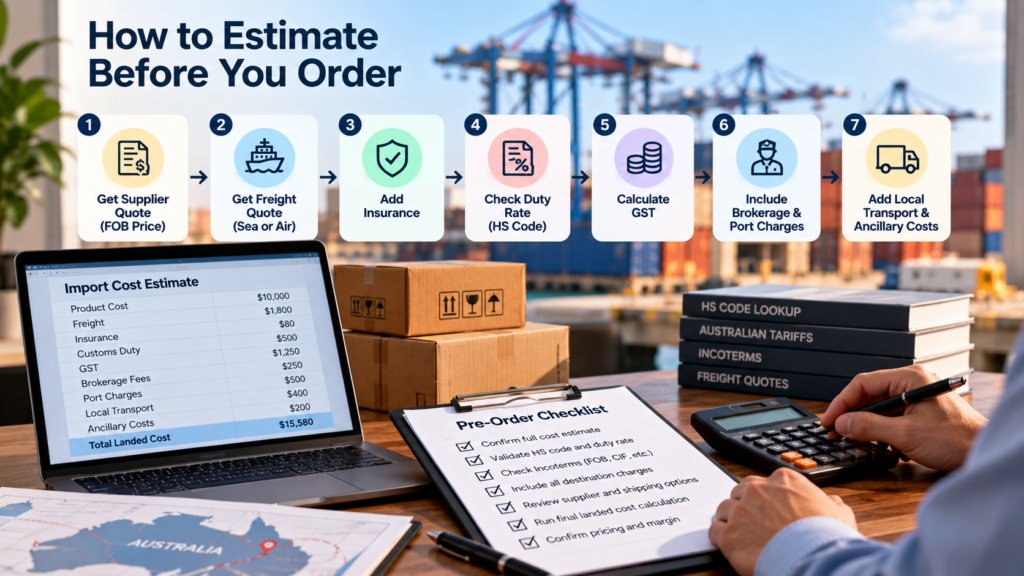
1. Get the supplier’s FOB price in writing. Confirm the currency and any additional charges (packaging, palletisation, export documents).
2. Request a freight quote from your forwarder. Provide cargo volume, weight and destination port. Ask for an all-in quote including origin and destination charges.
3. Identify the tariff classification (HS code). Your customs broker can classify the goods. This determines the duty rate.
4. Check FTA eligibility. If the origin country has an FTA with Australia, request a Certificate of Origin from your supplier to claim reduced duty.
5. Calculate GST on the CIF + duty + IPC value. Even if reclaimable, budget for the cash outlay at clearance.
6. Add brokerage and destination charges. Terminal handling, brokerage fees and port transport are consistent per shipment. Get these from your forwarder.
7. Include a contingency for surprises. Add 5 to 10 per cent buffer for currency fluctuation, potential biosecurity inspection or handling variations.
A good freight forwarder will provide a fully itemised landed cost estimate before you commit, so you can price and plan with confidence.
7. Common Landed Cost Mistakes
1. Only budgeting for freight. Freight is one component of many. Skipping duty, GST, brokerage and destination charges will always understate your true cost.
2. Assuming CIF and FOB give the same duty base. Australia calculates duty on FOB value regardless of the Incoterm used. Even if you buy CIF, duty is calculated on the underlying FOB portion.
3. Forgetting the Import Processing Charge. The IPC is a per-declaration government fee. Small in isolation but adds up across shipments.
4. Not claiming FTA preferences. Missing a Certificate of Origin can add 5 per cent to your duty bill on qualifying goods.
5. Ignoring currency fluctuation. If your supplier invoices in USD but you pay after production, the exchange rate at customs clearance may differ from your original quote.
6. Overlooking container detention risk. If your warehouse cannot unload the container within the shipping line’s free days, detention charges of $85 to $150 per day add up fast.
7. Using the wrong tariff classification. A wrong HS code can mean overpaying or underpaying duty. Underpayment triggers backdated assessments and penalties.
8. Key Takeaways
Summary: Estimating landed cost accurately
- Landed cost is the total cost to get goods from supplier to your warehouse: product + freight + insurance + duty + GST + IPC + brokerage + port + transport.
- Product cost alone typically represents 60 to 75 per cent of the final landed cost.
- Australia calculates duty on FOB value. GST is 10 per cent of CIF + duty + IPC.
- FTAs can eliminate duty on qualifying goods, but only with a valid Certificate of Origin.
- A worked example shows landed cost can be 30 to 50 per cent higher than the supplier price alone.
- Always calculate landed cost before setting retail prices or committing to orders.
- A good freight forwarder provides an itemised landed cost estimate upfront.
- Add a small contingency for currency movement and potential inspections.
9. Frequently Asked Questions
What is landed cost?
Landed cost is the total cost of getting an imported product from your supplier’s premises to your warehouse in Australia. It includes product cost, freight, insurance, customs duty, GST, brokerage fees, port charges and local transport.
How do I calculate landed cost for Australian imports?
Use this formula: Landed Cost = Product Cost + International Freight + Insurance + Customs Duty + GST + Import Processing Charge + Brokerage + Destination Charges + Port Transport. Ask your freight forwarder for a full itemised estimate before you place your order.
How much does customs duty cost in Australia?
Customs duty is typically 0 to 5 per cent of the FOB value for most manufactured goods. The exact rate depends on the tariff classification (HS code) and whether Free Trade Agreement preferences apply.
Is GST included in landed cost?
Yes. GST at 10 per cent is a component of landed cost. For GST-registered businesses, it is reclaimable as an input tax credit on your BAS, but you still need to fund it at the time of clearance.
How much extra should I budget beyond the product price?
As a rough guide, expect the total landed cost to be 30 to 50 per cent above the supplier’s FOB price. This includes freight, duty, GST, brokerage, port charges and local transport. Get an itemised quote from your freight forwarder for accuracy.
Do Free Trade Agreements reduce landed cost?
Yes, significantly. FTAs like ChAFTA (China), CPTPP (Vietnam, Japan and others), RCEP and AUSFTA (USA) reduce or eliminate customs duty on qualifying goods. You need a valid Certificate of Origin from your supplier to claim the preferential rate.
What are hidden costs in landed cost calculation?
Common overlooked costs include destination terminal handling charges, container detention fees, biosecurity inspection charges, shipping line administration fees, currency fluctuation losses and port storage. These can add 10 to 20 per cent on top of the visible costs.
Can Sea Logic provide a landed cost estimate?
Yes. Sea Logic provides fully itemised landed cost estimates before your shipment so you can budget accurately and set retail pricing with confidence. Contact our team to request a pre-shipment cost estimate.
Want an itemised landed cost estimate before your next order? Ask Sea Logic for a pre-shipment cost breakdown. Call 03 9114 8543 or contact us at sealogic.com.au