

For containerised sea freight, choosing suitable equipment affects freight cost, cargo protection, loading and the handovers at origin and destination. Not all sea freight travels in containers; non-standard cargo may need a separate break-bulk or project-cargo assessment. Standard 20-foot and 40-foot containers cover most commercial shipments, but the world of shipping containers is broader than many importers and exporters realise, with specialised options that can significantly change what you pay and how you ship.
This guide explains the main container types used in international sea freight, their dimensions and weight limits, when to use each, and how container choice interacts with cargo type and freight cost.
What are the standard shipping container sizes?
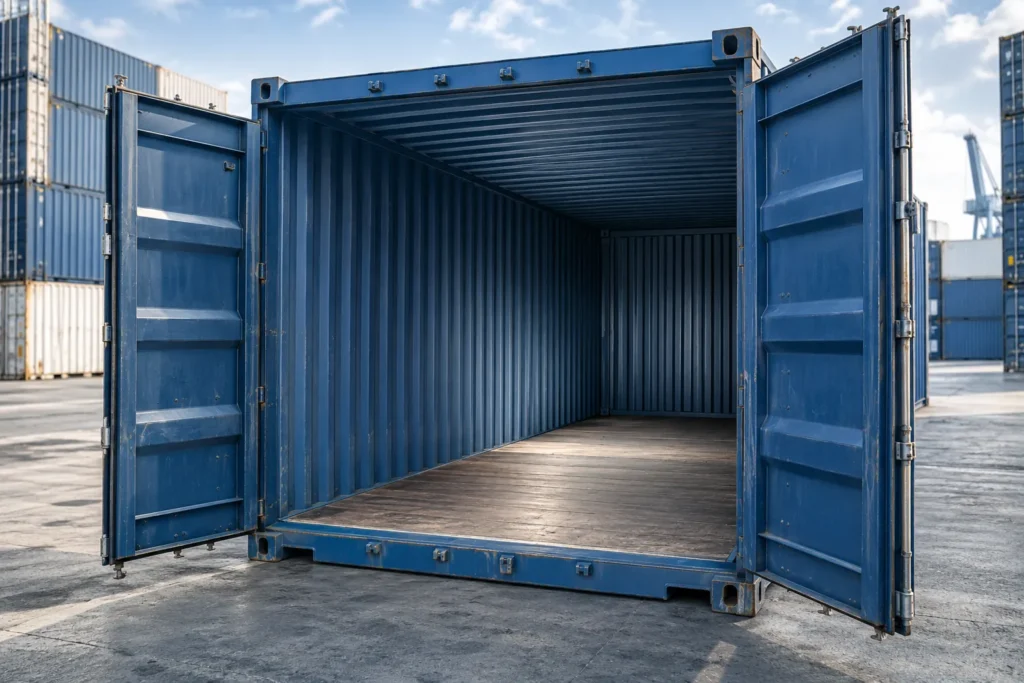
Standard shipping container sizes are 20-foot and 40-foot lengths, with additional variants including 40-foot high cube (taller version) and 45-foot high cube, all built to ISO standards that allow them to move interchangeably between ships, trucks, and rail worldwide.
The four size categories most commonly used:
- 20-foot standard (20’GP): the workhorse of international sea freight
- 40-foot standard (40’GP): double the length, most common for larger shipments
- 40-foot high cube (40’HC): same length as 40′ standard but 30 centimetres taller
- 45-foot high cube (45’HC): longer variant used on some trade lanes
Because containers are ISO-standardised, a container loaded in Shanghai is compatible with cranes, chassis, and rail systems everywhere else in the world. This standardisation is the reason global sea freight works the way it does.
What are the dimensions and weight limits of standard containers?
Standard 20-foot containers have approximately 33 cubic metres of usable internal volume, 40-foot containers have approximately 67 cubic metres, and 40-foot high cubes have approximately 76 cubic metres, all with maximum payload weights around 28 tonnes.
Typical specifications:
20-foot standard (20’GP)
- External length: 6.06 metres
- Internal length: 5.90 metres
- Internal width: 2.35 metres
- Internal height: 2.39 metres
- Usable volume: approximately 33 cubic metres
- Maximum payload: approximately 28,200 kilograms
40-foot standard (40’GP)
- External length: 12.19 metres
- Internal length: 12.03 metres
- Internal width: 2.35 metres
- Internal height: 2.39 metres
- Usable volume: approximately 67 cubic metres
- Maximum payload: approximately 26,700 kilograms
40-foot high cube (40’HC)
- Same length and width as 40′ standard
- Internal height: 2.69 metres (30 centimetres taller)
- Usable volume: approximately 76 cubic metres
- Maximum payload: approximately 26,600 kilograms
Note that maximum payload depends on the specific container and destination country road weight limits. Australian road regulations sometimes restrict fully loaded containers, particularly for road transport beyond the port.
What specialised container types are available?
Specialised containers include refrigerated containers (reefers), open top containers, flat rack containers, tank containers, and ventilated containers, each designed for cargo types that don’t fit standard dry containers.
The main specialised categories:
- Refrigerated (reefer) containers: temperature-controlled units for perishable cargo like seafood, meat, dairy, fruit, and pharmaceuticals. Available in 20-foot and 40-foot lengths
- Open top containers: no fixed roof, allowing cargo taller than standard height to be loaded from above using a crane. Commonly used for machinery, timber, and oversized industrial equipment
- Flat rack containers: no roof or sides, used for oversized, heavy, or awkwardly shaped cargo like boats, vehicles, or large machinery
- Tank containers: cylindrical stainless steel tanks inside a container frame, used for bulk liquids including chemicals, food-grade liquids, and dangerous goods
- Ventilated containers: standard containers with ventilation openings, used for cargo needing airflow like coffee, cocoa, and raw agricultural produce
- Insulated containers: thermal insulation without active refrigeration, used for cargo requiring stable temperature but not active cooling
Each specialised container has different pricing, availability, and booking requirements compared to standard containers.
When should you use a 20-foot vs 40-foot container?
Use a 20-foot container when cargo volume is under 25 cubic metres, weight is heavy relative to volume, or you need higher shipping frequency, and use a 40-foot container when cargo volume exceeds 25 cubic metres and weight is light-to-moderate.
Practical guidance:
- Heavy dense cargo (steel, tiles, machinery): often loads a 20-foot container to weight limit before filling the volume. 20′ is the right choice
- Light bulky cargo (garments, foam, plastic goods): fills a 40′ or 40’HC by volume before reaching weight limit. 40′ or 40’HC is more cost-efficient per cubic metre
- Split shipments: two 20-footers offer more flexibility for split origin locations or split destinations than one 40-footer
- Higher shipping frequency: 20-footers ship on more sailings and offer more capacity flexibility
The cost difference between 20′ and 40′ is not double, despite the size difference. A 40′ typically costs 30-50% more than a 20′, which is why 40′ becomes cheaper per cubic metre once cargo exceeds 20-25 cubic metres.
When should you use a high cube container?
Use a high cube container when cargo is light and bulky, when you need extra vertical space for tall goods, or when the extra 30 centimetres of internal height meaningfully increases your loadable volume.
Practical situations:
- Tall cargo that doesn’t fit in standard height containers
- Light bulky cargo where extra volume converts directly to more units shipped
- Furniture, foam products, plastic goods, garments and similar light cargo often benefit from high cube
- Automotive parts and consumer electronics where tall packaging or racking is used
High cube containers typically cost a small premium over standard 40-foot containers, but the extra 9 cubic metres of volume often justifies the premium multiple times over for the right cargo.
When should you use a refrigerated (reefer) container?
Use a refrigerated container when cargo requires active temperature control throughout the shipment, including frozen or chilled food products, pharmaceuticals, flowers, and certain chemicals.
Common reefer applications:
- Frozen and chilled meat, seafood, and dairy
- Fresh fruit and vegetables with specific temperature and humidity settings
- Pharmaceuticals and vaccines requiring cold chain integrity
- Wine for premium quality preservation on long voyages
- Flowers and horticultural products
- Chemicals requiring stable temperature
Reefer bookings need advance planning because reefer container availability is more constrained than dry container availability, and reefer freight rates are significantly higher than standard container rates due to power costs and specialised handling.
When should you use open top or flat rack containers?
Use open top or flat rack containers when cargo cannot be loaded through standard container doors, exceeds standard container height, has awkward shapes, or requires crane loading from above or the side.
Typical scenarios:
- Machinery too tall for standard containers: open top allows overhead crane loading and the tarpaulin roof accommodates height overhang
- Long timber, pipes, or steel bars: flat rack allows cargo to extend beyond standard container dimensions
- Vehicles, boats, and yachts: flat rack allows loading directly onto the deck without container doors
- Wind turbine blades, industrial equipment: flat rack accommodates oversized cargo where standard containers don’t fit
Open top and flat rack containers have specific cargo securing requirements and often trigger additional shipping charges for out-of-gauge cargo, but they enable shipments that would otherwise require break bulk or specialised project cargo services.
How does container choice affect freight cost?
Container choice affects freight cost through the container rate itself, container availability on the trade lane, weight limits, volume utilisation, and any specialised handling required at both ends of the shipment.
Cost drivers to consider:
- Container rate: standard rates apply per container regardless of fill; specialised containers cost more
- Weight or measure billing: some lanes use “revenue tonne” pricing that charges the higher of weight or volume, which affects container size choice
- Reefer power charges: reefer containers include ongoing electricity charges during transit
- Out-of-gauge surcharges: open top and flat rack cargo often attracts additional charges for cargo extending beyond container dimensions
- Repositioning costs: certain specialised containers require repositioning after use, which the shipping line may bill to the shipper
- Detention and demurrage: unused container time at both ends carries daily charges
Understanding how your cargo fills different container types is worth spending time on. A small change in packing or container choice can meaningfully change per-unit shipping cost.
How does container choice interact with FCL vs LCL decisions?
Container type only becomes a decision when shipping FCL, since LCL shippers don’t choose containers directly, and the FCL vs LCL decision itself is separate from container size choice.
For a fuller look at when FCL makes sense versus LCL, see our guide on FCL vs LCL sea freight, which covers the break-even points and decision framework.
How does container information appear on shipping documents?
Container numbers, container types, and seal numbers appear on the Bill of Lading and are used to identify the specific containers carrying your cargo, match them to customs declarations, and confirm cargo integrity throughout transit.
For a fuller look at how shipping documents work, see Bill of Lading explained. For how Incoterms shape responsibilities for container handling and freight, see Incoterms explained.
How does container availability affect shipping decisions?
Container availability varies by trade lane, season, and shipping line, and shortages can delay shipments or push cargo into different container types than planned, which is why booking capacity in advance and understanding container-specific lead times matters.
Common availability issues:
- Reefer container shortages in high-demand periods for perishables
- Container imbalances on specific trade lanes creating shortages at origin
- Peak season constraints particularly around Chinese New Year and Christmas shipping seasons
- Specialised container lead times for open top, flat rack, and reefer bookings
For a fuller look at why sea freight shipments run into delays and how to plan around them, see why sea freight shipments get delayed.
How Sealogic supports container selection
Sealogic coordinates container booking as part of sea freight services across Australia, including selecting the right container type for your cargo, checking availability on your trade lane, coordinating specialised container requirements, and managing container release, delivery, and empty return to minimise detention charges.
FAQs
What are the most common shipping container sizes?
The most common shipping container sizes are 20-foot standard, 40-foot standard, and 40-foot high cube, with 45-foot high cube used on some trade lanes.
How much can a 40-foot container hold?
A 40-foot standard container holds approximately 67 cubic metres of usable volume with a maximum payload of about 26,700 kilograms, while a 40-foot high cube holds approximately 76 cubic metres of usable volume.
What is the difference between a standard and a high cube container?
A high cube container is 30 centimetres (one foot) taller than a standard container of the same length, providing extra vertical space and about 9 cubic metres more usable volume in a 40-foot high cube compared to a 40-foot standard.
When should I use a refrigerated container?
Use a refrigerated container when cargo requires active temperature control throughout the shipment, including frozen or chilled food products, pharmaceuticals, wine, flowers, and temperature-sensitive chemicals.
What is a flat rack container used for?
A flat rack container is used for oversized, heavy, or awkwardly shaped cargo that cannot fit through standard container doors, including vehicles, boats, machinery, and long items like timber or pipes.
How do I know if I need a 20-foot or 40-foot container?
Use a 20-foot container for cargo under approximately 25 cubic metres or heavy dense cargo, and use a 40-foot container for cargo over 25 cubic metres or light bulky cargo where volume matters more than weight.
Does Sealogic help with container type selection?
Yes. Sealogic reviews container type options as part of routine shipment planning, matches container choice to cargo type, weight, and volume, and coordinates specialised container requirements for reefer, open top, flat rack, and other non-standard shipments.
Choosing equipment for an Australian export
Confirm the actual equipment available at the Australian origin before committing to a loading plan. Provide final packed measurements, gross weight, access requirements and any lifting or temperature needs. The container’s door opening, payload, condition and suitability for the cargo must be checked alongside road and terminal constraints. Agree who supplies the container, packs and secures the goods, and delivers it within the booked receiving window. Generic capacity figures are a starting point, not a confirmation that the load is suitable.
Plan your export from Australia: collection, loading, documents, cut-offs and overseas handover.
Conclusion
Container choice looks like a small technical decision, but it affects freight cost, cargo protection, and shipment reliability across the whole supply chain. Understanding container types, dimensions, and specialised options helps importers and exporters make deliberate choices rather than accepting whatever the shipping line defaults to. To discuss container selection on a specific shipment or ongoing trade lane, contact the Sealogic team.