
Three letters on a supplier invoice can determine thousands of dollars in unexpected costs.
Incoterms are the international rules that decide who pays for what and who is responsible when things go wrong during a shipment. Get them right and you have a clear, predictable landed cost. Get them wrong and you might end up paying for freight, insurance and clearance that you thought your supplier was handling — or vice versa.
For Australian importers, four Incoterms dominate day-to-day trade: FOB, CIF, EXW and DDP. This guide explains what each one means, who is responsible for what, and how to choose the right term for your imports.
Table of Contents
1. What Are Incoterms?
2. Why Incoterms Matter for Australian Importers
3. FOB (Free on Board) Explained
4. CIF (Cost, Insurance and Freight) Explained
5. EXW (Ex Works) Explained
6. DDP (Delivered Duty Paid) Explained
7. Side-by-Side Comparison
8. How to Choose the Right Incoterm
9. Common Incoterm Mistakes to Avoid
10. Key Takeaways
11. FAQs
1. What Are Incoterms?
Quick Definition: Incoterms (International Commercial Terms) are a set of 11 standardised three-letter rules published by the International Chamber of Commerce (ICC) that define the responsibilities of buyers and sellers in international trade. They specify who pays for freight, insurance and customs clearance, who arranges transport at each stage, and at what point risk transfers from the seller to the buyer. The current version is Incoterms 2020.
Incoterms appear on your commercial invoice as a code followed by a location: ‘FOB Shanghai’ or ‘DDP Melbourne’. That short line settles who does what across the entire shipment, without needing pages of contractual language.
There are 11 Incoterms in total, but Australian importers deal most often with four: FOB, CIF, EXW and DDP. The others (FCA, CPT, CIP, DAP, DPU, FAS, CFR) are used less frequently or in specific industry contexts.
2. Why Incoterms Matter for Australian Importers
Beyond defining who pays for what, Incoterms have a direct impact on Australian import costs in three ways:
– Landed cost accuracy: the Incoterm determines what your supplier’s price does and does not include. If you assume freight is included when it is not, your landed cost calculation is wrong from the start.
– Duty calculation: Australia calculates customs duty on the FOB value of your goods, regardless of the Incoterm actually used. This affects how much duty you pay.
– Risk transfer: the point at which risk transfers from seller to buyer determines who is liable if the cargo is damaged, lost or delayed at each stage.
Choosing the wrong Incoterm can add 15 to 30 per cent in hidden costs to a shipment. Choosing the right one gives you control and predictability.
3. FOB (Free on Board) Explained
FOB: The seller delivers the goods loaded on board a nominated vessel at the origin port and handles export clearance. From the moment the goods cross the ship’s rail, all costs and risks transfer to the buyer.
What the seller pays:
– Goods and packaging
– Transport to origin port
– Export clearance and duties
– Terminal handling at origin (loading onto vessel)
What the buyer pays:
– Ocean freight to destination
– Marine cargo insurance
– Terminal handling at destination
– Import duties, GST and clearance
– Local transport to warehouse
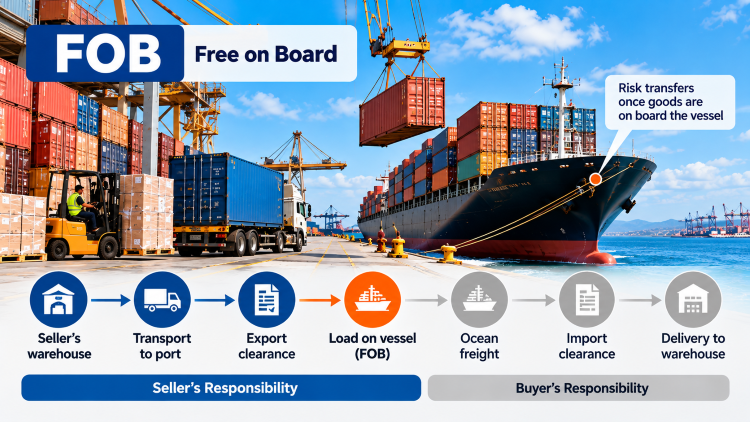
Best for: Most Australian importers, particularly those wanting control over freight and insurance costs. FOB is the standard Incoterm for sea freight imports because it gives you the ability to choose your own freight forwarder negotiate rates directly with carriers and control the shipping process from origin port onwards.
Note for air freight: FOB is technically only for sea freight. The air freight equivalent is FCA (Free Carrier), where the seller delivers goods to the origin airport or a nominated carrier.
4. CIF (Cost, Insurance and Freight) Explained
CIF: The seller pays for the goods, freight and marine insurance to the destination port. However, risk transfers to the buyer as soon as the goods are loaded on board at the origin port, even though the seller is paying for freight and insurance.
What the seller pays:
– Everything under FOB
– Ocean freight to Australian destination port
– Marine cargo insurance (minimum cover only)
What the buyer pays:
– Terminal handling at destination
– Import duties, GST and clearance
– Local transport to warehouse
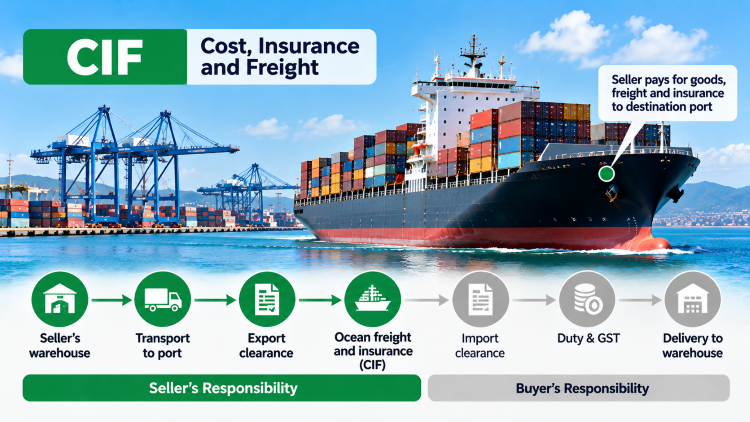
Best for: Importers who want a simpler pricing structure with freight and insurance bundled into the supplier’s quote. Common for smaller shipments or when the buyer does not have preferred freight relationships.
Expert Tip: With CIF, the seller’s freight and insurance rates are typically higher than what an Australian freight forwarder would charge directly. You are effectively paying a markup for convenience. Also note that CIF insurance is minimum cover only, so consider whether you need additional cargo cover. Importantly, Australia still calculates customs duty on the FOB value — freight and insurance are added back into the calculation for GST but not duty.
5. EXW (Ex Works) Explained
EXW: The seller makes the goods available at their own premises (factory, warehouse). From that point, the buyer is responsible for everything, including loading the goods at the seller’s premises, transport to the origin port, export clearance, ocean freight, insurance and all destination costs.
What the seller pays:
– Goods and packaging only
What the buyer pays:
– Loading at seller’s premises
– Transport from seller to origin port
– Export clearance in country of origin (buyer’s responsibility)
– Ocean freight and insurance
– All destination costs
– Import duties, GST and clearance
– Local transport to warehouse
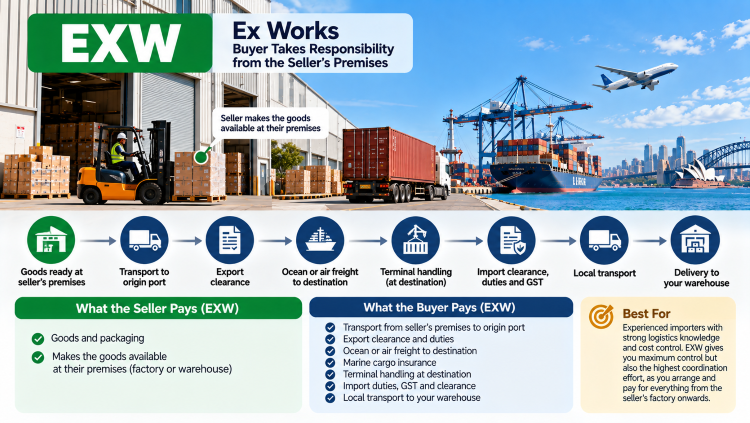
Best for: Experienced importers with established relationships and expertise in the origin country. EXW gives the lowest supplier price but shifts significant complexity to the buyer, including handling export clearance in the seller’s country. Not recommended for first-time importers.
6. DDP (Delivered Duty Paid) Explained
DDP: The seller takes responsibility for the entire shipment from their premises to the buyer’s nominated address in Australia, including all costs and risks — freight, insurance, import duties, GST and local transport.
What the seller pays:
– Everything from origin to buyer’s door in Australia, including all duties and taxes
What the buyer pays:
– Nothing beyond the quoted DDP price
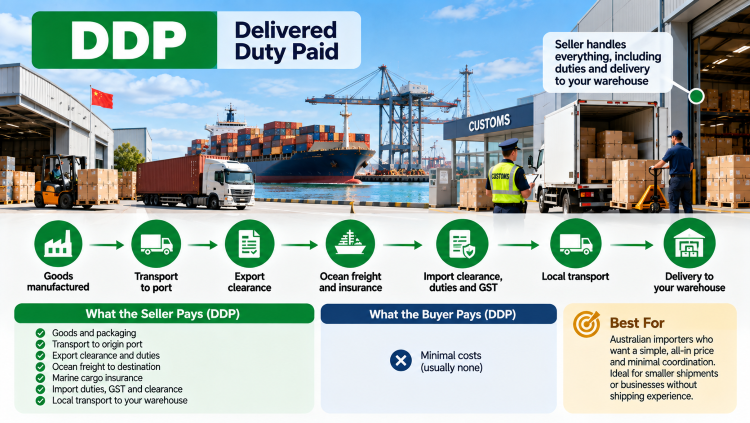
Best for: Buyers who want maximum simplicity and are willing to pay a premium for a fully delivered price. Common for small e-commerce orders, gifts and cross-border retail sales.
Expert Tip: DDP looks convenient but often costs significantly more than arranging the same shipment yourself. The seller marks up freight, insurance and customs charges, and may not be familiar with Australian customs requirements. There are also practical issues: the seller must be able to act as the importer of record in Australia, which is not always possible. For most commercial imports, DAP (Delivered at Place) is a better alternative where the seller delivers but the buyer handles Australian customs.
7. Side-by-Side Comparison
| Responsibility | EXW | FOB | CIF | DDP |
| Origin transport | Buyer | Seller | Seller | Seller |
| Export clearance | Buyer | Seller | Seller | Seller |
| Ocean freight | Buyer | Buyer | Seller | Seller |
| Marine insurance | Buyer | Buyer | Seller | Seller |
| Destination handling | Buyer | Buyer | Buyer | Seller |
| Import clearance | Buyer | Buyer | Buyer | Seller |
| Duty & GST | Buyer | Buyer | Buyer | Seller |
| Delivery to warehouse | Buyer | Buyer | Buyer | Seller |
| Risk transfer point | Seller’s door | On vessel at origin | On vessel at origin | Buyer’s door |
8. How to Choose the Right Incoterm
The best Incoterm for your business depends on three factors: your experience, your carrier relationships and how much control you want.
| Your Situation | Recommended Incoterm | Why |
| First-time or occasional importer | CIF | Simpler pricing, less coordination needed |
| Regular commercial importer | FOB | Control over freight, better long-term rates |
| High-volume importer with origin presence | EXW | Maximum cost control if you have expertise |
| Small e-commerce buyer | DDP | Simplest for one-off orders |
| Air freight shipment | FCA | Correct term for air freight (FOB equivalent) |
For most Australian importers, FOB is the default recommendation. It gives you control over freight and insurance, uses your relationship with a local freight forwarder and customs broker, and aligns with how Australian customs duty is calculated.
If you are unsure which term suits your specific situation, Sea Logic’s freight forwarding team can help you evaluate options based on your cargo, volume and business goals.
9. Common Incoterm Mistakes to Avoid
1. Comparing quotes with different Incoterms. If one supplier quotes EXW Shanghai and another quotes CIF Melbourne, you are not comparing like-for-like. Always request quotes on the same Incoterm to compare accurately.
2. Assuming CIF or DDP is cheaper because it ‘includes’ more. Suppliers markup freight, insurance and clearance costs. Arranging these yourself with a
freight forwarder often works out cheaper.
3. Overlooking risk transfer point. Under CIF, the seller pays for freight and insurance but risk transfers to you at the origin port. If cargo is damaged in transit, you claim on the CIF insurance policy — which may only offer minimum cover.
4. Using FOB for air freight. FOB is a sea-freight-only term. For air freight, use FCA (Free Carrier).
5. Choosing EXW without origin capability. EXW places export clearance and origin transport in your hands. If you do not have relationships or expertise in the seller’s country, this becomes expensive and complicated fast.
6. Assuming DDP means no import responsibilities. DDP requires the seller to act as the importer of record in Australia. Some sellers cannot legally do this, leading to confusion at the border.
7. Not confirming the Incoterm version. Contracts should reference ‘Incoterms 2020’ specifically. Older versions have different rules and can create disputes.
10. Key Takeaways
Summary: Incoterms for Australian importers
– Incoterms 2020 are the international rules that define who pays for what and who bears risk in international shipping.
– The four most common terms for Australian importers are FOB, CIF, EXW and DDP.
– FOB is the recommended default: buyer controls freight, insurance and Australian clearance.
– CIF bundles freight and insurance into the supplier price but typically at a markup.
– EXW places maximum responsibility on the buyer, suitable only for experienced importers.
– DDP is fully delivered but often expensive and legally complex for the seller in Australia.
– Australia calculates customs duty on FOB value regardless of the Incoterm actually used.
– Always compare supplier quotes using the same Incoterm to compare accurately.
11. Frequently Asked Questions
What are Incoterms?
Incoterms (International Commercial Terms) are 11 standardised three-letter rules published by the International Chamber of Commerce that define who pays for freight, insurance and customs clearance in international trade, and where risk transfers between the buyer and seller. The current version is Incoterms 2020.
What is the difference between FOB and CIF?
Under FOB, the seller delivers goods to the origin port and the buyer pays for freight, insurance and everything from that point. Under CIF, the seller pays for freight and insurance to the destination port, but risk still transfers to the buyer once goods are loaded at origin. FOB gives you more control, CIF gives you a simpler bundled price.
Which Incoterm is best for Australian importers?
FOB is the recommended default for most Australian importers. It gives you control over freight and insurance costs, lets you use your preferred freight forwarder and customs broker, and aligns with how Australian customs duty is calculated (on FOB value).
What does DDP mean in shipping?
DDP (Delivered Duty Paid) means the seller takes full responsibility for delivering goods to the buyer’s nominated address in Australia, including freight, insurance, customs duty, GST and local transport. The buyer pays nothing beyond the quoted DDP price.
Why does Australia use FOB for customs duty calculation?
Australian customs duty is calculated on the FOB value (goods price plus origin costs before freight and insurance) regardless of the Incoterm actually used. This provides a consistent duty base across all shipments. GST is calculated on the CIF value plus duty plus IPC.
Can I use FOB for air freight?
Technically no. FOB is a sea-freight-only Incoterm. For air freight, the correct equivalent is FCA (Free Carrier), where the seller delivers goods to the origin airport or a nominated carrier. In practice, some suppliers still use FOB loosely for air shipments, but FCA is the correct term.
What happens if my supplier and I do not agree on an Incoterm?
Without a specified Incoterm, disputes over costs and responsibilities are almost guaranteed. Always agree on the Incoterm before placing an order and include it on the commercial invoice and purchase order. Specify the version as ‘Incoterms 2020’.
Not sure which Incoterm suits your imports? Talk to Sea Logic about choosing the right shipping terms for your business. Call 03 9114 8543 or contact us at sealogic.com.au