
Standard shipping containers work for most cargo. But some things just do not fit.
Heavy machinery, structural steel, wind turbine blades, large vehicles, generators, prefabricated modules and industrial plant components all share a common challenge: they exceed the internal dimensions or weight limits of a standard 20-foot or 40-foot container. When that happens, containerised shipping is no longer an option.
This is where break bulk shipping comes in. It is a specialised approach used across Australia’s mining, construction, energy and infrastructure sectors to move cargo that cannot travel by container.
This guide explains what break bulk shipping is, when it makes sense to use it, how the process works and how to plan a break bulk shipment successfully.
For standard containerised shipping, see our FCL vs LCL guide and sea freight import guide .
Table of Contents
- What Is Break Bulk Shipping?
- Break Bulk vs Containerised Shipping
- When Does Break Bulk Make Sense?
- Types of Cargo That Ship as Break Bulk
- Vessel Types Used for Break Bulk
- Container Alternatives for Oversized Cargo
- How Break Bulk Shipping Works: Step by Step
- Key Planning Considerations
- Common Break Bulk Mistakes
- Key Takeaways
- FAQs
1. What Is Break Bulk Shipping?
Quick Definition: Break bulk shipping is the transportation of goods that are loaded individually onto a vessel rather than packed inside standard shipping containers. Cargo is typically secured on pallets, in crates, on cradles or lashed directly to the vessel’s deck or hold. It is used for oversized, heavy, irregularly shaped or high-value goods that cannot be safely or practically containerised.
The term dates back to the era before containerisation, when nearly all sea cargo moved as break bulk. Today, break bulk is a specialised service for cargo that does not fit standard container profiles. It is often used interchangeably with ‘project cargo’ when the shipment supports a specific engineering or construction project.
Sea Logic offers break bulk and project cargo services for Australian importers moving oversized freight from origin survey through to on-site delivery.
2. Break Bulk vs Containerised Shipping
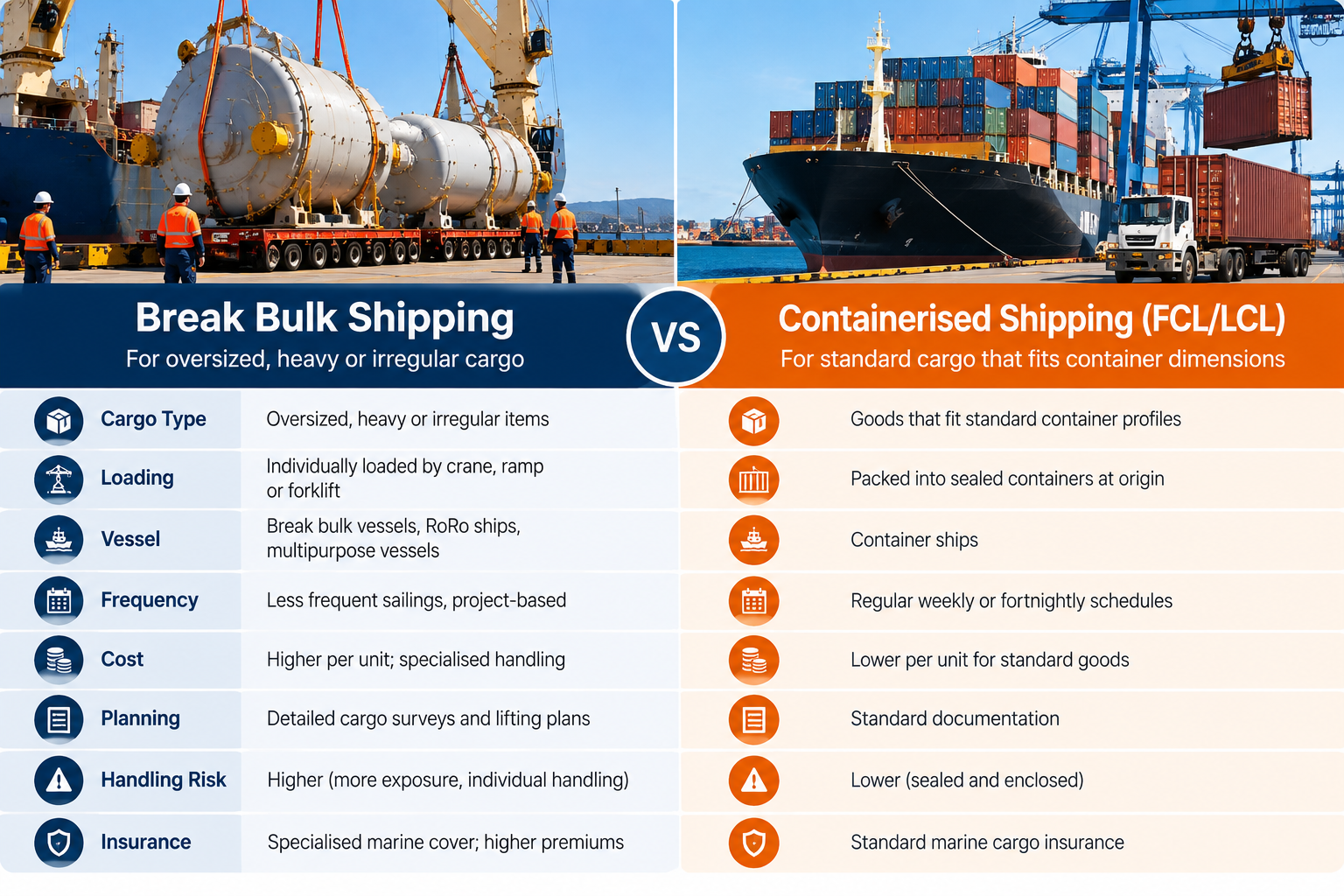
| Factor | Break Bulk | Containerised (FCL/LCL) |
| Cargo Type | Oversized, heavy or irregular items | Goods that fit standard container profiles |
| Loading | Individually loaded by crane, ramp or forklift | Packed into sealed containers at origin |
| Vessel | Break bulk vessels, RoRo ships, multipurpose vessels | Container ships |
| Frequency | Less frequent sailings, project-based | Regular weekly or fortnightly schedules |
| Cost | Higher per unit; specialised handling | Lower per unit for standard goods |
| Planning | Detailed cargo surveys and lifting plans | Standard documentation |
| Handling Risk | Higher (more exposure, individual handling) | Lower (sealed and enclosed) |
| Insurance | Specialised marine cover; higher premiums | Standard marine cargo insurance |
3. When Does Break Bulk Make Sense?
Break bulk is the right choice in specific scenarios. Here are the situations where it makes commercial and practical sense:
Cargo Exceeds Container Dimensions
If any single item is longer, wider, taller or heavier than a standard container can accommodate, containerisation is not possible. Standard container limits are approximately 12 metres long, 2.35 metres wide, 2.39 metres high and 28 tonnes in weight for a 40-foot container.
Cargo Is an Awkward Shape
Some cargo fits within container dimensions but cannot be safely loaded due to its shape (curved, extending brackets, protrusions). Break bulk allows individual securing to accommodate these forms.
Weight Distribution Requires Specialist Handling
Extremely heavy point loads (heavy machinery, engines, transformers) may exceed a container’s floor load-bearing capacity even if they fit dimensionally. Break bulk allows the load to be distributed across cradles or a vessel’s reinforced deck.
Project Cargo with Coordinated Delivery
Large infrastructure or industrial projects often require multiple oversized components delivered on a coordinated schedule. Break bulk vessels can be booked to accommodate the full project shipment together.
Ro-Ro Suits Wheeled Cargo
For vehicles, trucks, mobile machinery and rolling stock, Roll-on/Roll-off (RoRo) services allow cargo to be driven directly on and off the vessel. This is a form of break bulk that avoids the need for cranes and crating entirely.
Expert Tip: If your cargo could fit in a flat rack or open top container on a regular container vessel, that is often more cost-effective than a dedicated break bulk shipment. Discuss both options with your freight forwarder to compare cost and timing.
4. Types of Cargo That Ship as Break Bulk
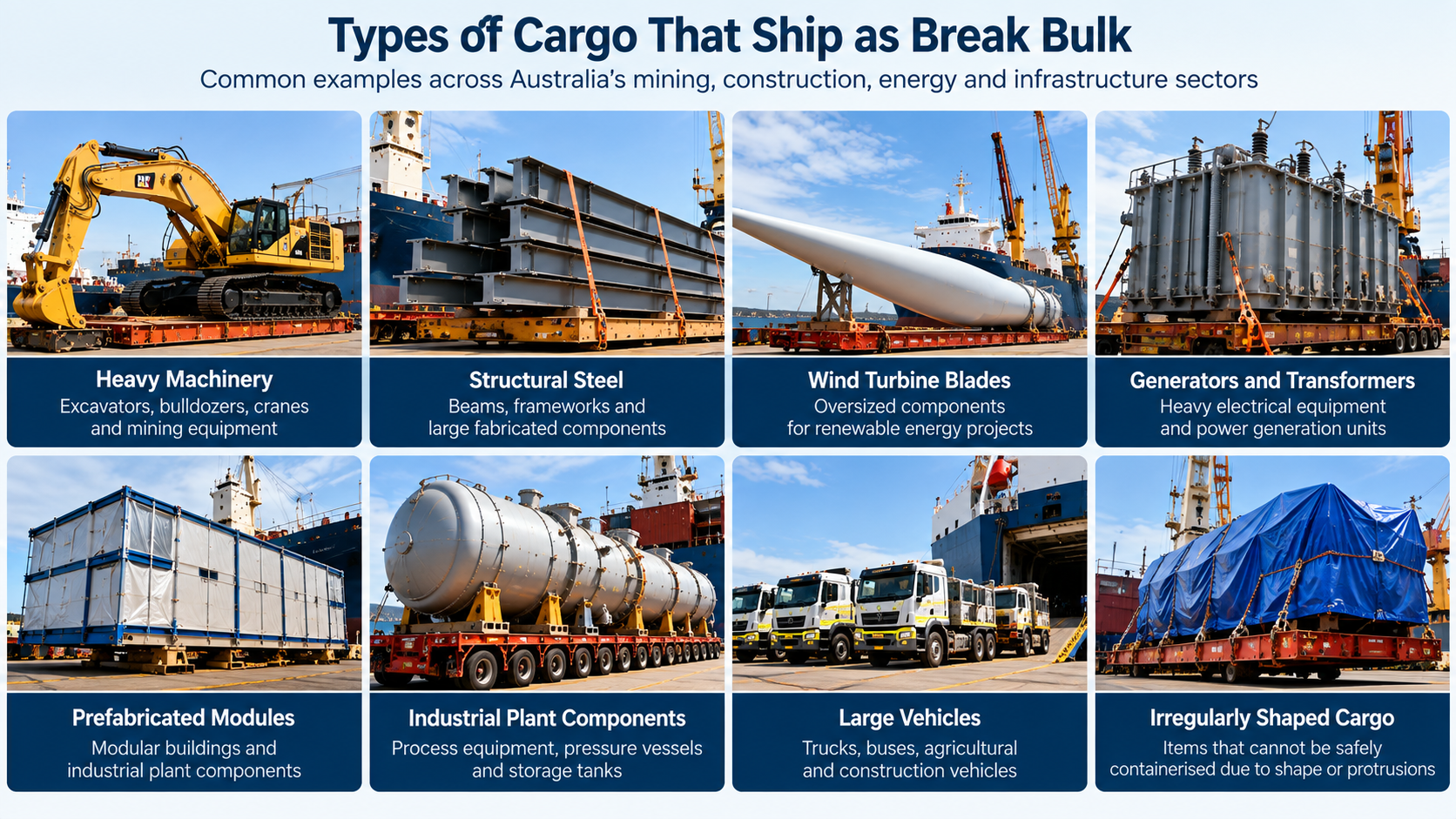
Common break bulk cargo categories in Australia include:
– Construction equipment: excavators, cranes, prefabricated modules, structural steel
– Mining machinery: haul trucks, crushers, conveyor systems, processing plant
– Industrial plant: generators, transformers, boilers, turbines, pressure vessels
– Vehicles and rolling stock: buses, trucks, rail carriages, agricultural equipment
– Renewable energy: wind turbine blades and towers, solar farm structures
– Marine vessels: boats, yachts, pontoons, small ships
– Oil and gas equipment: drilling components, pipes, refinery modules
– Infrastructure: bridge sections, tunnel boring machinery, rail track sections
5. Vessel Types Used for Break Bulk
| Vessel Type | How It Works | Best For |
| General Cargo Vessel | Multipurpose ship with cranes and holds | Standard break bulk, mixed cargo |
| Heavy Lift Vessel | Vessels with high-capacity cranes (500+ tonnes) | Very heavy single pieces |
| RoRo (Roll-on/Roll-off) | Cargo driven on and off via ramps | Wheeled and tracked cargo |
| Open Hatch Bulk | Reinforced holds for forestry, project cargo | Long lengths, forestry, steel |
| Container Vessel (flat rack) | Standard container ship using OOG container types | Oversized cargo that fits on flat racks |
6. Container Alternatives for Oversized Cargo
For cargo that exceeds standard container dimensions but not by a huge margin, specialised container types on regular container vessels can be a more cost-effective alternative to a dedicated break bulk shipment:
– Flat rack containers: no sides or roof, just a reinforced base with end walls. Cargo is lashed to the base.
– Open top containers: standard container with a removable tarpaulin roof for cargo taller than 2.39 metres.
– Platform containers: flat base with no walls or roof, for very large heavy items loaded by crane from any side.
These options let you use regular container shipping schedules while still moving cargo that would not fit in a standard box.
7. How Break Bulk Shipping Works: Step by Step
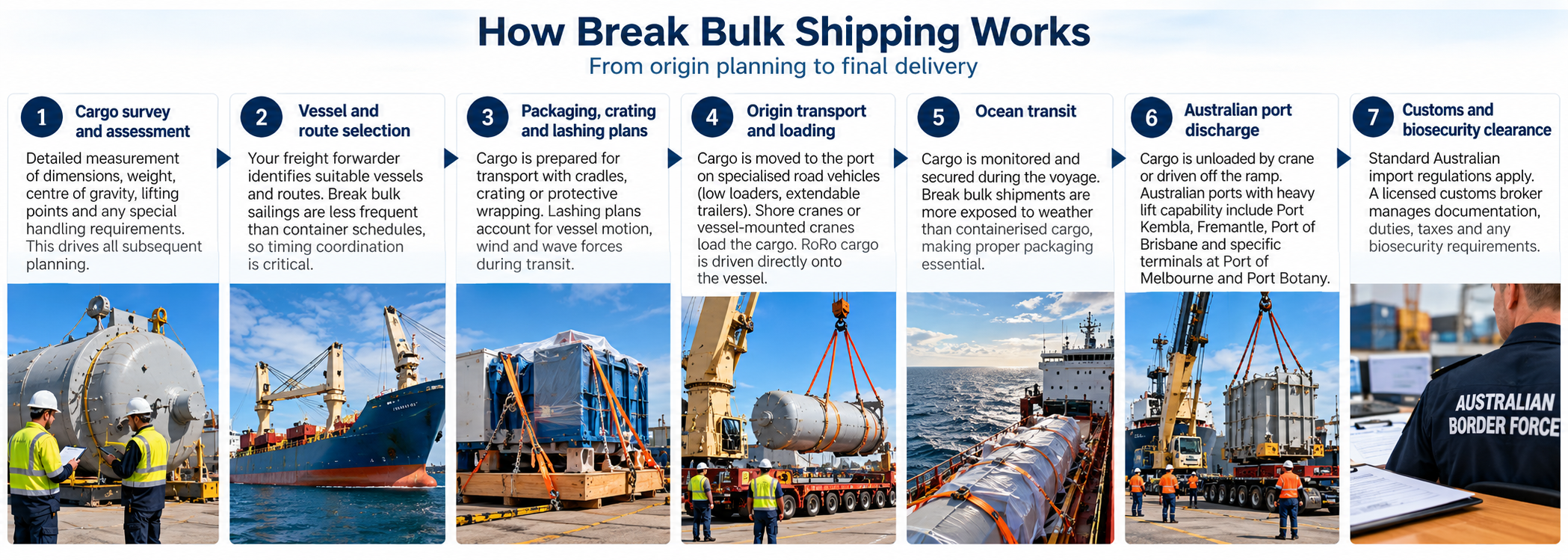
- Cargo survey and assessment. Detailed measurement of dimensions, weight, centre of gravity, lifting points and any special handling requirements. This drives all subsequent planning.
- Vessel and route selection. Your freight forwarder identifies suitable vessels and routes. Break bulk sailings are less frequent than container schedules, so timing coordination is critical.
- Packaging, crating and lashing plans. Cargo is prepared for transport with cradles, crating or protective wrapping. Lashing plans account for vessel motion, wind and wave forces during transit.
- Origin transport and loading. Cargo is moved to the port on specialised road vehicles (low loaders, extendable trailers). Shore cranes or vessel-mounted cranes load the cargo. RoRo cargo is driven directly onto the vessel.
- Ocean transit. Cargo is monitored and secured during the voyage. Break bulk shipments are more exposed to weather than containerised cargo, making proper packaging essential.
- Australian port discharge. Cargo is unloaded by crane or driven off the ramp. Australian ports with heavy lift capability include Port Kembla, Fremantle, Port of Brisbane and specific terminals at Port of Melbourne and Port Botany.
- Customs and biosecurity clearance. Standard Australian import regulations apply. A licensed customs broker handles declaration and clearance regardless of cargo type.
8. Key Planning Considerations
- Start early. Break bulk shipments need 6 to 10 weeks of planning. Vessel availability, port crane bookings, road permits and site preparation all require lead time.
- Provide accurate cargo data. Measurement errors are the most common and most expensive break bulk mistake. Always use surveyed dimensions and weights.
- Apply for road transport permits. Oversized loads on Australian roads require permits from state authorities. Wide loads may need pilot vehicles or police escorts.
- Confirm port crane capacity. If your cargo exceeds port shore crane capacity, you need a vessel with onboard cranes or a floating crane arrangement.
- Arrange specialised insurance. Standard marine cargo policies may exclude uncontainerised or deck-loaded cargo. Discuss coverage with your broker before shipping.
- Prepare the delivery site. Ensure adequate access for heavy haulage, ground bearing capacity, unloading equipment and staff on the day of delivery.
9. Common Break Bulk Mistakes
- Inaccurate cargo measurements. Wrong dimensions mean wrong equipment, wrong vessel and potentially a failed loading.
- Insufficient lead time. Break bulk cannot be arranged like standard containers. Booking too late reduces vessel options and increases cost.
- Forgetting road transport permits. Moving oversized cargo without permits is illegal and delays delivery significantly.
- Underestimating port crane requirements. Booking a vessel that cannot be discharged at the destination port.
- Inadequate insurance coverage. Assuming standard marine policies cover break bulk cargo when they often do not.
10. Key Takeaways
Summary: When break bulk shipping makes sense
– Break bulk is for cargo that cannot fit in standard shipping containers due to size, weight or shape.
– Common cargo: heavy machinery, structural steel, industrial plant, vehicles, renewable energy components.
– Options include dedicated break bulk vessels, RoRo services, and OOG containers (flat racks, open tops) on regular container ships.
– Break bulk costs more per unit than containerised freight but is the only option for oversized cargo.
– Planning starts 6 to 10 weeks ahead with accurate cargo surveys, permits and vessel selection.
– Australian oversized road transport requires state permits and often escorts.
– Use a freight forwarder with specific break bulk experience — this is not a generalist shipment.
11. Frequently Asked Questions
What is break bulk shipping?
Break bulk shipping is the transportation of goods loaded individually onto a vessel rather than in shipping containers. It is used for oversized, heavy or irregularly shaped cargo that cannot fit in a standard container.
When should I use break bulk instead of a container?
Use break bulk when your cargo exceeds the internal dimensions or weight limits of a standard container (approximately 12 m long, 2.35 m wide, 2.39 m high, 28 tonnes for a 40-foot container). You may also need it for awkwardly shaped or extremely heavy cargo requiring specialist handling.
How much does break bulk shipping cost?
Break bulk costs more per unit than containerised freight due to specialised handling, equipment and less frequent vessel schedules. Costs are quoted per shipment based on cargo dimensions, weight, origin, destination and handling requirements. Request a detailed quote from a freight forwarder experienced in project cargo.
What is the difference between break bulk and project cargo?
The terms are often used interchangeably. Break bulk refers to the shipping method (individual loading). Project cargo refers to the purpose (supporting a specific engineering or construction project). Most project cargo shipments use break bulk methods, but not all break bulk is project cargo.
What is a RoRo vessel?
A Roll-on/Roll-off (RoRo) vessel has ramps that allow wheeled cargo (vehicles, trucks, tracked machinery) to be driven directly onto and off the ship. It is a form of break bulk shipping that avoids the need for cranes.
Do I need road transport permits for oversized cargo in Australia?
Yes. Cargo exceeding standard road transport limits (generally 2.5 m wide, 4.3 m high or standard axle weights) requires permits from state road authorities. Wide and heavy loads may also require pilot vehicles or police escorts.
Can Sea Logic handle break bulk shipments?
Yes. Sea Logic’s break bulk services cover the full logistics chain including origin surveys, vessel booking, customs clearance, port handling and heavy haulage delivery to your site.
Have oversized or project cargo to move? Talk to Sea Logic about the right break bulk solution. Call 03 9114 8543 or enquire at sealogic.com.au