Licensed Customs Broker Services for Australian Importers and Exporters
Sealogic provides customs brokerage and customs clearance services for businesses importing and exporting goods through Australia. Our team manages the full customs process on your behalf including import declarations, tariff classification, duty and GST assessment, Australian Border Force (ABF) compliance, and export documentation so your goods clear the border without unnecessary delays or compliance risks.
Whether you are a regular importer managing high-volume container shipments or a business exporting Australian goods to international markets for the first time, our experienced customs team handles the complexity and keeps you informed throughout.
Customs clearance is the mandatory process by which goods imported into or exported from Australia are assessed, documented, and approved by the Australian Border Force (ABF) and, where required, the Department of Agriculture, Fisheries and Forestry (DAFF). Without correct customs clearance, goods cannot legally enter or leave Australia.
For importers, customs clearance involves lodging an Import Declaration through the ABF’s Integrated Cargo System (ICS), paying the correct duties and GST, obtaining any required permits, and satisfying biosecurity requirements set by DAFF. Errors in tariff classification, incorrect valuations, or missing documentation can result in delays, fines, or cargo being held at the border.
For exporters, the process involves completing an Export Declaration, complying with any export controls or prohibitions, and ensuring goods meet the import requirements of the destination country.
Sealogic’s customs brokerage team manages this process for you lodging declarations, classifying goods correctly, identifying applicable duty concessions, liaising with ABF and DAFF, and ensuring your cargo moves through Australian customs as quickly and compliantly as possible.
We provide a comprehensive range of customs brokerage and trade compliance services for Australian importers and exporters.
Import Customs Clearance We manage the complete import customs clearance process for goods arriving at Australian ports and airports. This includes reviewing your commercial invoice and shipping documents, assigning the correct HS tariff codes, calculating duties and GST, lodging your Import Declaration via the ABF’s Integrated Cargo System (ICS), and obtaining the Authority to Deal (ATD) that releases your goods for delivery. Our team monitors your clearance status and responds promptly to any ABF queries or inspection requests to minimise delays. |
Export Customs Documentation For Australian exporters, we prepare and lodge Export Declarations with the ABF, ensure goods comply with Australian export controls and prohibitions, and provide documentation that meets the import requirements of the destination country. We also advise on country of origin documentation, certificates of origin, and any specific requirements for regulated goods including food, agricultural products, and controlled materials. |
Tariff Classification Correct tariff classification is the foundation of compliant customs clearance. We determine the appropriate Harmonised System (HS) tariff code for your goods based on their composition, function, and intended use. Incorrect classification is one of the most common causes of customs delays, penalties, and overpayment of duties. Our team stays current with the Australian Customs Tariff and ABF classification rulings to ensure your goods are declared accurately. |
Duty and GST Assessment We calculate customs duty, import GST, and any applicable additional charges (including the Wine Equalisation Tax, Luxury Car Tax, or excise duties for regulated goods) accurately before lodgement. We also identify goods that may qualify for duty exemptions, concessions under by-laws, or Tradex Order benefits. Accurate upfront assessment avoids underpayment penalties and ensures you do not overpay on your imports. |
DAFF Biosecurity Compliance All goods imported into Australia are subject to biosecurity screening by the Department of Agriculture, Fisheries and Forestry (DAFF). Certain goods including food, plant material, animal products, timber, and soil require additional permits, treatments, or inspections before they can be released. Our team identifies biosecurity requirements for your cargo before it arrives in Australia, manages permit applications, and coordinates with DAFF to minimise the risk of holds or directed treatment. |
Customs Audit Support If your business is subject to a customs audit by the ABF, our team provides support throughout the process. We review your import records, identify any classification or valuation discrepancies, assist in preparing responses to ABF queries, and represent your interests during the audit. Proactive compliance review before an audit can significantly reduce the risk of penalties. |
Ongoing Trade Compliance For businesses with regular import or export activity, we provide ongoing customs compliance support including periodic tariff classification reviews, monitoring of regulatory changes affecting your product categories, FTA concession eligibility assessments, and advice on record-keeping requirements under the Customs Act 1901. Staying ahead of compliance obligations reduces audit risk and keeps your supply chain running without interruption. |
One of the most valuable services a customs broker provides is identifying Free Trade Agreement (FTA) concessions that reduce the import duty on your goods. Australia’s network of FTAs covers many of the country’s largest trading partners, and eligible importers can save significantly on duty costs in many cases reducing rates to zero.
ChAFTA China-Australia FTA Covers a broad range of goods including electronics, machinery, textiles, and consumer products. Many HS categories now attract 0% duty for Chinese-origin goods with a valid Certificate of Origin. | AUSFTA Australia-United States FTA Provides duty-free treatment for most US-origin goods including industrial equipment, technology products, and agricultural commodities with qualifying documentation. |
AANZFTA ASEAN-Australia-NZ FTA Covers imports from Singapore, Malaysia, Thailand, Vietnam, Indonesia, Philippines, Brunei, Cambodia, Laos, and Myanmar. Significant for businesses importing manufactured goods from Southeast Asia. | JAEPA Japan-Australia EPA Provides preferential duty rates for Japanese-origin goods including automotive parts, electronics, and industrial equipment. |
KAFTA Korea-Australia FTA Covers goods originating in South Korea, including electronics, vehicles, components, and steel products. | CPTPP Comprehensive and Progressive Agreement A multilateral agreement covering Canada, Japan, Mexico, Vietnam, Singapore, New Zealand, Chile, Brunei, Malaysia, and Peru. Enables preferential rates across a wide range of goods from member countries. |
To claim FTA concessions, importers must hold a valid Certificate of Origin or equivalent origin documentation from the supplier. Our customs brokerage team advises on the documentation required for each agreement and ensures concessions are correctly applied at the time of import declaration.
Understanding the clearance process helps you prepare documentation early and avoid the delays that result from incomplete or incorrect lodgements. Here is how we manage your import customs clearance from start to finish.
Document Collection
As soon as your goods are shipped, send us your Commercial Invoice, Packing List, and Bill of Lading or Airway Bill. Early documentation allows us to begin classification and duty assessment before your goods arrive, enabling pre-clearance in many cases.
Tariff Classification and Duty Calculation
We assign the correct HS tariff codes to each product line, calculate customs duty at the applicable rate, apply any FTA concessions or by-law exemptions, and calculate import GST on the Value of Taxable Importation (VoTI). You receive a clear breakdown of expected costs before your goods arrive.
DAFF Biosecurity Check
We identify whether your goods require biosecurity permits, treatment, or inspection under DAFF requirements. For regulated goods, we lodge the necessary permit applications or advise on treatment options to ensure your cargo is ready for clearance on arrival.
Import Declaration Lodgement
We lodge your formal Import Declaration via the ABF’s Integrated Cargo System (ICS). For goods with a customs value above AUD 1,000, a formal declaration is required. We ensure all fields are accurate and complete to minimise the risk of ABF queries.
ABF Assessment and ATD
The ABF assesses your declaration and issues an Authority to Deal (ATD) once your goods are cleared. If the ABF raises a query, requests additional documentation, or directs an inspection, we respond promptly on your behalf to resolve the hold as quickly as possible.
Duty and GST Payment
We coordinate payment of assessed duties, GST, and any applicable government charges. For registered importers, GST may be deferred to your Business Activity Statement under the Deferred GST scheme.
Goods Released for Delivery
Once the ATD is issued and duties are paid, your goods are released from the port or airport and can be delivered to your premises. We coordinate this handoff with your freight forwarder or transport provider.
Accurate Tariff Classification We classify your goods correctly from the outset, reducing the risk of ABF compliance issues, duty underpayments, and clearance delays caused by incorrect HS codes. | FTA Concession Expertise We actively identify applicable Free Trade Agreement concessions for your imports, ensuring you claim every available duty reduction and avoid overpaying on landed costs. |
ABF and DAFF Liaison We manage all communication with the Australian Border Force and the Department of Agriculture on your behalf, responding to queries and inspection requests promptly to keep your goods moving. | Integrated with Freight Services Because Sealogic also provides sea freight, air freight, and port transport services, customs clearance is managed as part of a single, coordinated logistics workflow reducing handoff delays between providers. |
Import and Export Coverage We handle customs requirements for both imports arriving at Australian ports and airports, and exports leaving Australia for international destinations. | Ongoing Compliance Support Beyond individual clearances, we provide ongoing trade compliance advice, tariff classification reviews, and regulatory monitoring to keep your import operations compliant as rules change. |
Customs requirements vary significantly across industries. Some product categories require specialist permits, additional biosecurity screening, or specific documentation that goes beyond a standard Import Declaration. Our team has experience across the following sectors:
Food and Beverage Imported food products are subject to DAFF biosecurity screening and must comply with the Australia New Zealand Food Standards Code. We manage import permits, biosecurity declarations, and food labelling compliance documentation. | Pharmaceutical and Healthcare Pharmaceuticals, medical devices, and biologics may require TGA registration, import permits, and specific customs declarations. We coordinate compliance across ABF, TGA, and DAFF requirements. |
Chemicals and Hazardous Materials Industrial chemicals, pesticides, and hazardous goods are subject to NICNAS/AIIC registration, dangerous goods regulations, and additional import controls. We ensure correct classification and permit management for regulated chemical imports. | Retail and Consumer Goods Regular importers of consumer goods benefit from ongoing classification reviews, FTA concession management, and streamlined declaration lodgement to keep inventory arriving on schedule. |
Automotive and Machinery Vehicles, automotive parts, and industrial machinery may be subject to SEVS approvals, compliance plates, or ADR standards. We advise on applicable requirements and manage customs documentation accordingly. | Textiles and Apparel Textile imports often qualify for FTA concessions and require specific country of origin documentation. We manage HS classification and FTA eligibility assessments for clothing, fabric, and apparel importers. |
Technology and Electronics Electronic goods require correct HS classification, ACMA compliance declarations where applicable, and accurate valuation. We manage declaration lodgement and FTA concession applications for technology importers. | Agricultural Products and Timber Australian biosecurity laws are particularly strict for agricultural goods, timber, and plant-based materials. We manage DAFF import permits, phytosanitary certificate requirements, and biosecurity treatment coordination. |
Need customs clearance or brokerage support? Talk to our team today.
A customs broker is a licensed professional who manages the customs clearance process on behalf of importers and exporters. In Australia, customs brokers are licensed by the Australian Border Force (ABF) under the Customs Act 1901. They prepare and lodge Import and Export Declarations through the ABF's Integrated Cargo System (ICS), classify goods under the correct HS tariff codes, calculate applicable duties and GST, identify FTA concessions, manage DAFF biosecurity requirements, and respond to any ABF queries or inspection requests. Using a customs broker reduces the risk of errors, delays, and non-compliance penalties.
Customs clearance costs in Australia include the customs broker's professional service fee, government charges from the ABF (including the Import Processing Charge), and any applicable customs duty and import GST. The Import Processing Charge for a formal Import Declaration is currently AUD 50.40 (subject to ABF updates). Customs duty is typically 5% of the customs value for most goods, though many goods attract 0% duty under FTA concessions or by-law exemptions. Import GST is 10% of the Value of Taxable Importation. Contact our team for a quote based on your specific goods and country of origin.
You are not legally required to use a customs broker for Australian imports, but it is strongly recommended for goods with a customs value above AUD 1,000 (which require a formal Import Declaration) or for any goods subject to biosecurity screening, permit requirements, or FTA concession claims. For low-value goods (under AUD 1,000), an SAC (Self Assessed Clearance) declaration can be lodged without a broker. For commercial import volumes, using a licensed customs broker significantly reduces the risk of errors, clearance delays, and compliance issues.
Standard import documentation includes a Commercial Invoice, Packing List, and Bill of Lading or Airway Bill. Additional documents may be required depending on your goods: Certificates of Origin for FTA concession claims, Import Permits for regulated goods, Phytosanitary Certificates for plant-based products, Treatment Certificates for biosecurity-treated goods, and Certificates of Analysis for food or chemical imports. Our team will advise on the specific documents needed for your cargo before it ships.
Free Trade Agreements (FTAs) between Australia and trading partners including China, the United States, Japan, South Korea, and ASEAN nations allow eligible goods to enter Australia at reduced or zero import duty rates. To claim FTA concessions, you must hold a valid Certificate of Origin or equivalent document from your supplier that confirms the goods meet the rules of origin requirements for the relevant agreement. Our customs brokerage team identifies applicable FTA concessions for your imports, reviews origin documentation, and ensures concessions are correctly applied at the time of Import Declaration lodgement.
Tariff classification is the process of assigning the correct Harmonised System (HS) code to your goods under the Australian Customs Tariff. Every imported product must be classified with the correct HS code, which determines the applicable duty rate, any import restrictions or permits required, and FTA concession eligibility. Incorrect classification is a common cause of customs delays, duty underpayments (which attract ABF penalties), and overpayment of duties. Our team classifies your goods accurately based on their composition, function, and intended use.
The Department of Agriculture, Fisheries and Forestry (DAFF) manages Australia's biosecurity laws, which control the risk of pests, diseases, and invasive species entering the country through imported goods. Many products including food, plant material, wood and timber, animal products, soil, and used machinery are subject to mandatory biosecurity inspection, treatment, or import permit requirements. Failing to comply with DAFF requirements can result in goods being held, directed for treatment at your cost, or destroyed. Our team identifies DAFF requirements for your cargo before it arrives in Australia and manages the permit and compliance process.
Yes. We manage customs clearance for goods both arriving at and departing from Australia. For imports, this includes ABF Import Declaration lodgement, tariff classification, duty and GST assessment, FTA concessions, and DAFF biosecurity compliance. For exports, we prepare and lodge Export Declarations, advise on export controls and prohibitions, and provide the documentation required by the destination country's customs authorities.
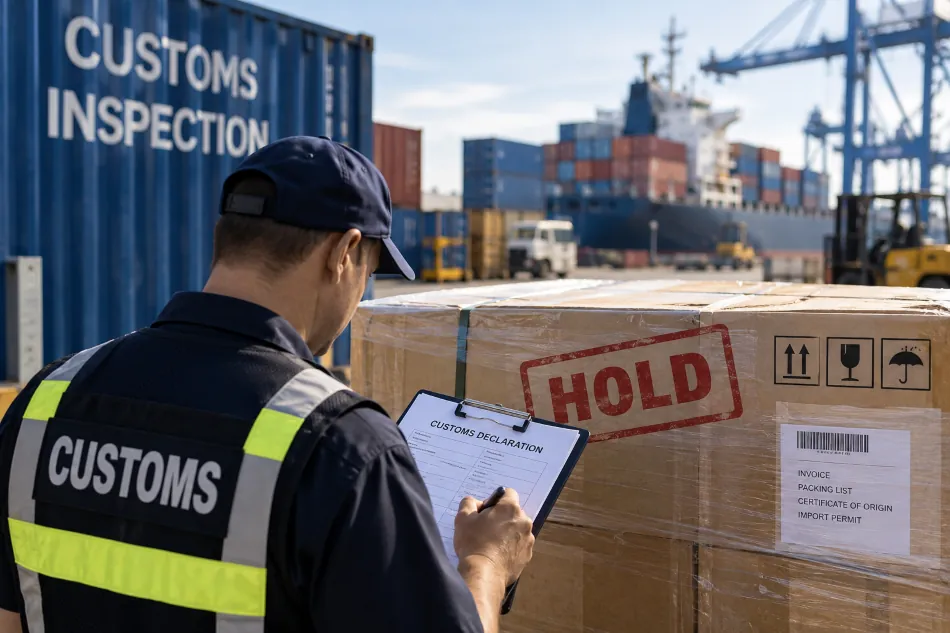
Goods can be held at the Australian border for several reasons: ABF queries about the Import Declaration, directed inspections for compliance checks, DAFF biosecurity holds requiring treatment or further assessment, or missing permits and documentation. When a hold is placed, the ABF issues a Direction to Hold or a request for additional information. Our team monitors your clearance status, responds to ABF and DAFF queries promptly, arranges any required inspections or treatments, and works to resolve the hold as quickly as possible to minimise storage and demurrage costs.
Yes. We manage customs clearance for sea freight arriving at all major Australian container ports including the Port of Melbourne, Port Botany in Sydney, the Port of Brisbane, Fremantle Port in Perth, and Port Adelaide. For air freight, we handle clearance at Melbourne Airport, Sydney Airport, Brisbane Airport, Perth Airport, and Adelaide Airport.
Pick up your phone and give us a call on 03 9114 8543!