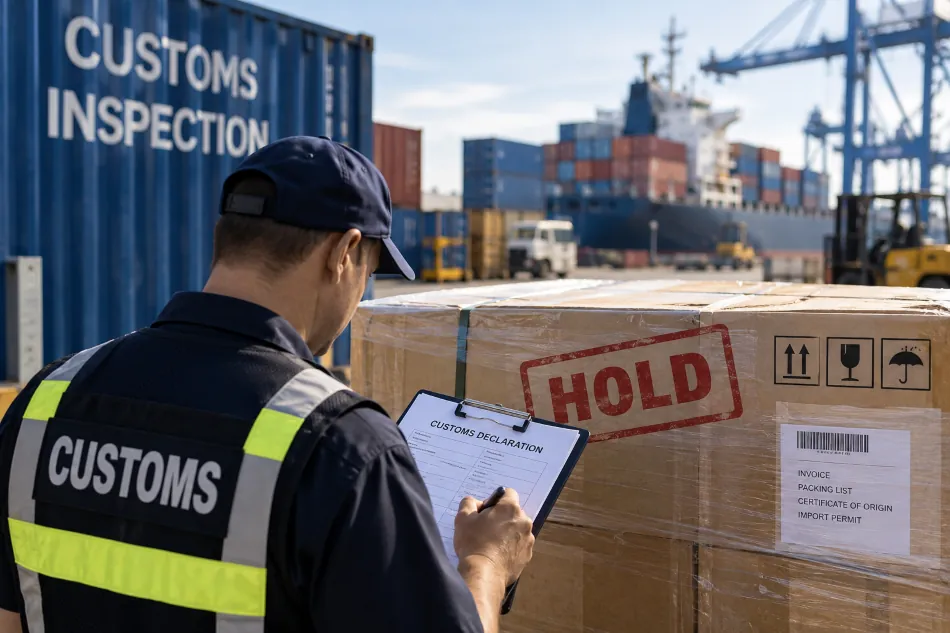

Every commercial shipment that arrives in Australia needs to clear customs before it can be released. That means someone has to declare what the goods are, where they came from, what they are worth and how much duty and tax is owed.
For most importers, that someone is a licensed customs broker.
Customs brokerage is one of those services that works quietly in the background when everything goes right. But when documentation is wrong, tariff codes are misclassified or compliance requirements are missed, the consequences hit fast: delays, penalty charges, goods stuck at the border and, in serious cases, seizure of cargo.
This guide explains what a customs broker actually does, how the clearance process works, what it costs and how to choose the right broker for your business.
For the full picture on how goods move from overseas to your warehouse, read our step-by-step sea freight import guide
Table of Contents
- What Is a Customs Broker?
- What Does a Customs Broker Actually Do?
- The Customs Clearance Process: Step by Step
- Do You Legally Need a Customs Broker?
- How Much Does Customs Brokerage Cost?
- How a Broker Saves You Money
- What to Look for When Choosing a Customs Broker
- Common Customs Clearance Mistakes
- Key Takeaways
- FAQs
What Is a Customs Broker?
Quick Definition: A customs broker is a licensed professional authorised by the Australian Border Force (ABF) to prepare, lodge and manage import declarations on behalf of importers. They act as your representative at the border, ensuring your goods comply with Australian trade, tax and biosecurity regulations so they can be legally released into the domestic market.
Think of a customs broker as the legal bridge between your cargo arriving at an Australian port or airport and that cargo being available for you to use or sell. Without clearance, your goods sit in a bonded area incurring storage charges.
Customs brokers must hold a licence issued under the Customs Act 1901. They are required to pass examinations set by the ABF and maintain ongoing compliance with professional standards. This is not a self-regulated industry. It is a licensed profession with legal accountability.
What Does a Customs Broker Actually Do?
A broker’s role goes well beyond lodging a form. Here is what a good customs broker handles for each shipment:
– Reviews your commercial invoice, packing list, bill of lading (or air waybill) and any certificates to check for accuracy and completeness
– Classifies your goods under the correct tariff code (HS code) to determine the applicable duty rate
– Identifies whether your goods qualify for reduced or zero duty under a Free Trade Agreement (such as ChAFTA, CPTPP, RCEP or AUSFTA)
– Prepares and lodges the import declaration (N10) through the Integrated Cargo System (ICS)
– Calculates customs duty, GST and any other applicable charges
– Manages biosecurity requirements and liaises with the Department of Agriculture, Fisheries and Forestry (DAFF) if your cargo is directed for inspection
– Arranges payment of duties and government charges on your behalf
– Advises on import permits, prohibited goods and regulatory compliance
– Provides the Entry Advice Note (EAN) once goods are cleared, which you need for GST input tax credit claims on your BAS
Expert Tip: The tariff classification step is where a broker’s expertise makes the biggest financial difference. Australia’s Customs Tariff has thousands of product codes, and the difference between two similar codes can mean a duty rate of 0 per cent versus 5 per cent. Across a year of importing, that adds up to a significant saving. Sea Logic’s customs brokerage team reviews every classification to ensure you are not paying more duty than necessary.
The Customs Clearance Process: Step by Step
Here is what happens from the moment your cargo is approaching Australia to when it is released for delivery:
- Pre-arrival lodgement. Your broker receives the shipping documents (commercial invoice, packing list, bill of lading or air waybill, packing declaration, certificate of origin) while your goods are still in transit. They prepare the import declaration and lodge it with the ABF through ICS before the vessel or aircraft arrives. This is called pre-lodgement, and it is the single most effective way to speed up clearance.
- ABF assessment. The ABF reviews the declaration, verifies the tariff classification and assesses the applicable duty and GST. At this point, the system may green-light your cargo for immediate release or flag it for further checks.
- Biosecurity screening. DAFF assesses whether the cargo requires a biosecurity inspection based on the packing declaration, goods description and risk profile. High-risk categories include timber packaging, food products, plant material and used equipment.
- Payment of duty and GST. Your broker arranges payment of customs duty, GST and the Import Processing Charge (IPC). Most brokers use a Deferred Payment Scheme (DPS) that allows duty and GST to be paid monthly rather than per shipment, which helps with cash flow.
- Cargo release. Once cleared and paid, the ABF issues an authority to release your goods. For sea freight, your container can then be collected from the wharf. For air freight, goods are released from the Cargo Terminal Operator’s warehouse. Sea Logic’s
port transport services handle the collection and delivery of cleared containers across all major Australian ports.
Do You Legally Need a Customs Broker?
Technically, no. Australian law allows you to lodge your own import declaration for goods valued under AUD 1,000 using a Self-Assessed Clearance (SAC) declaration. For goods valued over AUD 1,000, you can still self-lodge a Full Import Declaration (N10) through the ICS if you have access to the system.
In practice, almost all commercial importers use a broker. Here is why:
– The ICS is a technical system that requires training and accreditation to use effectively
– Incorrect tariff classification can result in overpaying duty or, worse, underpaying and facing backdated assessments and penalties from the ABF
– Biosecurity requirements are complex and change regularly
– Free Trade Agreement rules of origin are specific to each agreement and product category
– Errors cause delays, and delays at the port or airport cost money in storage and detention charges
For commercial importers, the cost of a broker is a fraction of the cost of getting it wrong.
How Much Does Customs Brokerage Cost?
Customs brokerage fees in Australia generally consist of two parts:
| Fee Type | What It Covers | Typical Range |
| Professional entry fee | Broker’s time, expertise and lodgement of the import declaration | $150 to $500 per entry |
| Import Processing Charge (IPC) | Government fee payable to ABF | $50 (goods $1,000-$10,000) or $152 (over $10,000) |
| Line item charges | Additional charge per product type in a multi-product shipment | $10 to $30 per additional line |
| DAFF biosecurity fees | If cargo is directed for inspection | $46+ document assessment; inspection fees vary |
| Permit lodgement | If goods require specific import permits | $50 to $150 per permit |
Some brokers quote a low base fee but add charges for disbursements, communication or after-hours processing. Always ask for a full schedule of fees upfront so you can compare on a like-for-like basis.
Regular importers often negotiate volume-based pricing. If you are lodging multiple declarations per week, your per-entry cost should reflect that consistency.
How a Broker Saves You Money
A good customs broker is not just a cost. They are a source of savings:
– Correct tariff classification avoids overpaying duty on every shipment
– FTA preference claims reduce or eliminate duty on qualifying goods (often saving 5 per cent of the FOB value)
– Pre-lodgement reduces time at port, avoiding container detention and storage charges
– Compliance accuracy avoids ABF penalties, which can include backdated duty assessments plus interest
– The Entry Advice Note they provide is your proof for claiming import GST credits on your BAS, which recovers 10 per cent of your customs value
If you have been importing for some time without claiming FTA preferences, a broker can also review your past declarations. In many cases, you can claim duty refunds for up to four years on goods that qualified for reduced rates under an applicable Free Trade Agreement.
Sea Logic arranges customs brokerage services through licensed brokerage partners, alongside freight forwarding and transport coordination. We help connect the information and responsibilities at each handover.
What to Look for When Choosing a Customs Broker
- Licensing. Confirm they hold a current customs broker licence issued by the ABF.
- Product experience. Ask whether they have cleared your specific product category before. A broker who regularly handles food imports, for example, will know the DAFF requirements inside out.
- Integrated services. Brokers who also offer freight forwarding and transport (like Sea Logic) provide a single point of contact, which reduces handoff delays and communication gaps.
- Transparent pricing. Look for a broker who provides a full fee schedule rather than a low headline rate with hidden extras.
- Pre-clearance capability. Your broker should be lodging declarations before your cargo arrives, not after it has already landed and is sitting at the port.
- FTA knowledge. If you import from countries covered by Australian FTAs, your broker should proactively identify duty savings opportunities.
Common Customs Clearance Mistakes
- Late documentation. Sending your documents to your broker after the vessel has arrived means your goods sit at the port waiting for clearance. Storage and detention charges accumulate daily.
- Incorrect or incomplete invoices. If the commercial invoice value does not match the declaration, the ABF will query it. Discrepancies cause delays and can trigger an audit.
- Wrong tariff classification. Misclassifying goods can lead to overpaying or underpaying duty. Underpayment results in backdated assessments, interest and potential penalties.
- Not claiming FTA preferences. Many importers pay full duty on goods that qualify for reduced or zero rates simply because they did not request a Certificate of Origin from their supplier.
- Ignoring biosecurity requirements. Non-compliant timber packaging, undeclared organic material or missing treatment certificates result in quarantine holds, fumigation costs and delays.
Key Takeaways
Summary: Customs brokerage for Australian importers
– A customs broker is a licensed professional who lodges import declarations and manages clearance on your behalf.
– The clearance process involves declaration lodgement, ABF assessment, biosecurity screening, duty/GST payment and cargo release.
– Professional brokerage fees typically range from $150 to $500 per entry, plus government charges.
– Correct tariff classification and FTA preference claims are the two biggest areas where brokers save you money.
– Pre-lodging your declaration before cargo arrives is the most effective way to speed up clearance.
– Always send your documents to your broker while goods are still in transit.
– Choose a licensed broker with product expertise, transparent pricing and integrated freight services.
Frequently Asked Questions
What is customs brokerage in Australia?
Customs brokerage is the professional service of preparing, lodging and managing import declarations with the Australian Border Force on behalf of importers. A licensed customs broker ensures your goods are correctly classified, the right duty and GST amounts are paid, and all regulatory requirements are met so your cargo can be legally released into the Australian market.
How much does a customs broker cost in Australia?
Professional entry fees typically range from $150 to $500 per declaration, depending on the complexity of the shipment and number of product lines. Government charges (the Import Processing Charge) add $50 to $152 per entry. Regular importers can often negotiate lower per-entry fees based on volume.
Do I need a customs broker to import into Australia?
It is not legally required, but it is strongly recommended for any commercial import. The clearance process involves technical systems (ICS), complex tariff classification and strict compliance requirements. A broker’s expertise reduces the risk of costly errors, delays and penalties.
How long does customs clearance take in Australia?
For compliant shipments with correct documentation, customs clearance typically takes 1 to 3 business days for sea freight and within 24 hours for air freight. If cargo is selected for biosecurity inspection, clearance can take 3 to 7 additional business days. Pre-lodging your declaration before the vessel arrives significantly speeds up the process.
What is the difference between a customs broker and a freight forwarder?
A freight forwarder manages the physical transportation of your goods from the supplier to your premises. A customs broker manages the legal clearance of those goods through Australian customs. At Sea Logic we coordinate freight forwarding and arrange customs clearance through licensed brokerage partners, with clear communication between the parties.
Can a customs broker help me pay less duty?
Yes. A broker ensures your goods are classified under the correct tariff code (some codes attract lower duty rates than others) and claims any applicable Free Trade Agreement preferences. They can also identify duty concession schemes and, for goods incorrectly classified in the past, lodge refund claims for up to four years of overpaid duty.
What documents does a customs broker need from me?
At a minimum: commercial invoice, packing list, bill of lading or air waybill, and packing declaration. If claiming FTA preferences, a Certificate of Origin is also required. Some goods need specific import permits. Send these documents to your broker as early as possible, ideally while the goods are still in transit.
What happens if my goods are held by customs in Australia?
Goods can be held for several reasons: incomplete documentation, incorrect declarations, biosecurity concerns or random compliance checks. Your customs broker liaises with the ABF and DAFF to resolve holds as quickly as possible. Additional costs may apply, including inspection fees, fumigation charges and port storage.
Need customs brokerage support for your imports? Sea Logic arranges clearance through licensed brokerage partners for shipments through Australian ports. Call 03 9114 8543 or request a consultation at sealogic.com.au